Innovation meets reality: AI’s next constraint is leadership, not technology
A major new IDC study, sponsored by Expereo, finds that enterprise AI ambition has run well ahead of enterprise readiness. Read across the Gulf, Europe and the markets in between, the pattern is the same. The organisations that pull away will be the ones that solve for people and leadership first.

The real story of enterprise AI in 2026 is an AI leadership gap, not a technology gap. The headline finding of Enterprise Horizons 2026, IDC’s survey of 800 multinational enterprises across the US, Europe and Asia/Pacific, is not that companies are ignoring AI. Almost everyone is investing. The finding is that ambition has outpaced the foundations required to convert it into value. AI adoption is broad, but true enterprise maturity lags behind. Most organisations sit in early or limited deployment, and many cannot yet turn AI activity into consistent business outcomes.
That gap is the whole story. It shows up first in the performance data. AI is clearly improving how work gets done: 90% of companies report gains in productivity, 84% in quality of work, 78% in customer experience. The economics are a different matter. Only half report a benefit to costs, and just 38% see any positive effect on workforce size or hiring rate. AI is changing output. It has not yet reshaped the underlying business.
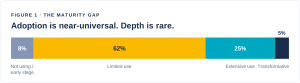
How extensively organisations use AI. Only 5% have reached transformative use; 62% remain in limited deployment. Source: IDC, Enterprise Horizons 2026, sponsored by Expereo (n = 800).
IDC is unambiguous about why. The shortfalls are driven less by the technology and more by foundations: data quality, skills and network performance. Among organisations where AI underperformed, the leading causes were poor data quality (51%), costs exceeding returns (47%), a lack of in-house skills (27%) and an inadequate network (26%). Among those where AI exceeded expectations, the differentiators were strong in-house skills (49%), strong network performance (46%) and high-quality training data (35%). Read those two lists together and the conclusion writes itself. AI success is an organisational and infrastructural problem before it is a modelling problem.
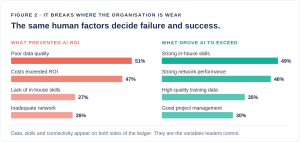
Factors cited by organisations where AI missed, versus exceeded, expectations. Source: IDC’s Global AI & Network Performance Survey, 2026 (n = 1,200+).
01 · TWO REGIONS, ONE GAP
The Gulf and Europe are failing the readiness test from opposite ends
The most useful way to understand this gap is to look at two markets that are approaching AI with almost mirror-image strategies, and arriving at the same wall.
The Gulf is buying its way in. AI is forecast to add up to 320 billion dollars to the Middle East economy by 2030, and the region’s states are building the physical stack to capture it. Saudi Arabia declared 2026 its Year of Artificial Intelligence and inaugurated Hexagon, described as the world’s largest government data centre. The UAE is developing a five-gigawatt AI campus in Abu Dhabi. Capital, compute and political will are not the constraint. Execution is. McKinsey found that only 31% of GCC organisations have scaled AI or deployed it fully, and Deloitte reports that while roughly 80% feel intense pressure to adopt, close to half name talent shortages and capability gaps as the barrier to scaling. Infrastructure without talent, as one regional analysis put it, is expensive real estate.
Europe is regulating its way in. The EU has treated AI as a governance question first: the AI Act, the Apply AI Strategy, GDPR and data-residency rules set the frame. The ambition is real, but the workforce is not keeping pace. Europe holds roughly nine to ten million ICT specialists against a Digital Decade target of twenty million by 2030, and around 55% of enterprises that try to recruit ICT specialists report difficulty filling the roles. The European Parliament’s own analysis suggests the bloc will reach only about 60% of its basic-digital-skills goal by 2030, a twenty-point shortfall. An EU AI Skills Academy launches in 2026 precisely because the gap is now structural, not cyclical.
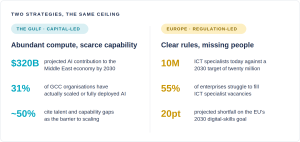
Two strategies, the same ceiling. Sources: Precedence Research and McKinsey (GCC); Deloitte Middle East; Eurostat and the European Commission; European Parliament Think Tank.
Capital solves for compute. Regulation solves for trust. Neither solves for the people who turn either one into value.
This is the point that matters for anyone running a business across EMEA. The regional detail differs, but the binding constraint converges on the same thing: the humans and the leadership needed to execute. IDC found the same signal inside its global data. Competition for talent is now rated a bigger risk to growth than cybersecurity or geopolitical threats by 58% of the companies most advanced in AI. Hiring for key technology roles takes markedly longer than it did a year ago for 62% of respondents. And the skills most urgently needed, led by cybersecurity, then AI and machine learning, then data engineering, map exactly onto this year’s top technology priorities. The scarcity is precisely where the value is.
02 · THE RESERVOIR IN BETWEEN
Central and Eastern Europe is the talent story both regions are missing
There is a third market sitting between the Gulf’s capital and Western Europe’s demand, and it is the one closest to our own footprint. Central and Eastern Europe now holds a developer pool commonly estimated at more than 1.8 million professionals, ranking among the strongest in the world for engineering quality, with deepening specialisation in exactly the scarce disciplines: AI and machine learning, cybersecurity, cloud and data engineering. Nearshoring into the region has changed character. It is no longer about cost arbitrage; it has become capability-driven, with outcome-based engagements replacing time-and-materials, and a reported 63% of CEE technology vendors now running dedicated AI and machine-learning practices.
The region is not a limitless well. Senior AI and leadership profiles are genuinely contested, demographic decline is tightening supply, and retention holds only where employers invest seriously in development. That is the important nuance. The advantage is no longer found by whoever shows up cheapest. It is found by whoever can identify, attract and hold the specific people who convert AI ambition into governed, executed value. That is a search-and-advisory problem, not a procurement one, and it is the work we do across our affiliate network in the region every day.
03 · THE VARIABLE THAT DECIDES IT
The AI leadership gap is the multiplier that decides outcomes
Strip the report back and the AI leadership gap sits above every other factor. IDC frames it plainly: AI is elevating the role of technology leaders from operational oversight to strategic business leadership, and a strong CIO and CFO partnership is what unlocks funding, speed and disciplined investment. The organisations that report a strong CIO-CFO alliance are far more likely to secure AI funding, to approve technology investment quickly, and to hold the line between innovation and cost.
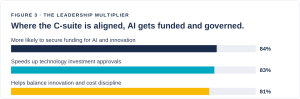
A strong CIO-CFO partnership is now a precondition for scaling AI, not a nicety. Respondents who agree or strongly agree. Source: IDC, Enterprise Horizons 2026.
The report also captures a structural shift in the shape of the C-suite. Among organisations scaling AI, 22% created a chief AI officer role in the past twelve months, over twice the rate seen across all companies. In the Gulf, that appetite is sharper still: analysis of GCC leaders finds them roughly four and a half times more likely than laggards to appoint a chief AI officer. New titles are appearing to own AI governance, ethics and internal capability, because the old operating model does not have a home for that accountability.
For a firm whose business is leadership, this is the through-line of the entire study. Every foundational gap IDC identifies, in data, in skills, in networks, resolves upward into a leadership question: who owns it, who funds it, who is accountable for turning spend into outcomes. Technology has become abundant. Judgement has not.
04 · WHAT THIS MEANS FOR HOW YOU BUILD YOUR TEAM
Seven moves for leaders closing the readiness gap
IDC’s own recommendations centre on execution discipline, foundational enablers and C-suite alignment. Seen through the lens of who you hire and how you lead, here is how we would translate that for boards and executive teams across EMEA.
- Hire for the accountability, not the acronym. The chief AI officer question is really a question about ownership. Before you create the title, define the mandate, the budget authority and the reporting line, or the role becomes governance theatre.
- Treat the CIO-CFO relationship as a hire-and-fit decision. The alliance that unlocks AI funding depends on two people who trust each other’s judgement. When you appoint either, assess for that partnership, not only the functional CV.
- Prioritise the scarce disciplines deliberately. Cybersecurity, AI and machine learning, and data engineering are where the shortage and the value coincide. Map your gaps against your top digital priorities and search where the depth actually is.
- Widen the map before you widen the budget. The Gulf shows that spending harder does not close a talent gap. Central and Eastern Europe holds deep, specialised engineering capability. A multi-market search beats a single-market bidding war.
- Build the retain plan alongside the hire plan. In tight specialist markets, the win is holding people. Development, mandate and progression now matter more than headline package. Design for it from day one.
- Reskill as a strategy, not a fallback. Fewer hires and higher-value skills is the emerging equation. Reinvest the savings into upskilling your existing base; it is often faster and more durable than an external search for the same capability.
- Put talent risk on the board agenda next to cyber risk. The most AI-advanced companies already rate competition for talent as a bigger growth risk than cyber or geopolitics. Govern it with the same seriousness.
Innovation has met reality, and reality is a leadership and talent problem. The technology is ready. The question for the next twelve months is whether your people, and the people leading them, are ready too. That is the conversation we are having with clients across the region, and it is the one worth having now.
SOURCE & FURTHER READING
- Primary source. IDC InfoBrief, Enterprise Horizons 2026: Where Innovation Meets Reality, sponsored by Expereo, June 2026 (doc #EUR154457526-IB). Analysts: James Eibisch, Martina Longo, Masarra Mohamed. Based on IDC’s Technology Leaders Survey, 2026 (n = 800) and IDC’s Global AI & Network Performance Survey, 2026 (n = 1,200+). All uncredited statistics on adoption, ROI, networks, cybersecurity, skills and leadership are drawn from this study.
- European Commission, Shaping and strengthening European AI talent, and AI talent, skills and literacy; digital-strategy.ec.europa.eu.
- European Commission, 2026 State of the Digital Decade report; Eurostat ICT specialist indicators (EU ICT workforce and enterprise recruitment difficulty).
- European Parliament Think Tank analysis on Digital Decade 2030 basic-digital-skills progress (2025-2026).
- McKinsey & Company, The state of AI in GCC countries: In pursuit of scale and value, November 2025.
- Deloitte Middle East, State of AI in the Middle East and 2026 trends outlook (Saudi Arabia and UAE).
- Precedence Research, How GCC Countries Are Transforming AI Investment into Long-Term Economic Growth (Middle East AI economic contribution to 2030; chief AI officer adoption).
- Kaplan MENA, Saudi Arabia’s AI Strategy 2026 (Year of AI; Hexagon data centre); Middle East Institute, AI, the Gulf, and the US, and From Crude to Compute.
- Roche et al., Artificial Intelligence and the GCC workforce, Humanities and Social Sciences Communications (Nature), 2025.
- Central and Eastern Europe talent data: Index.dev, Wise Step, Alcor and Tech StaQ 2026 market analyses (developer pool size, specialisation, nearshoring shift to capability).
This article is independent commentary by SpenglerFox. It references IDC and Expereo research for analysis and credit; it does not imply endorsement by IDC or Expereo. Third-party statistics are attributed to their publishers above.