The GCC C-Suite Imperative: Risk, Growth and Talent in 2026
What senior executives across the six Gulf states are telling us about where the real exposures sit, where growth still lives, and why leadership talent is on the move.
SpenglerFox Global Business Insights | Executive Survey, fieldwork August 2026
The GCC C-suite is leading through an exceptional period. Boardrooms across the Gulf are taking decisions this year that will shape the region’s leadership landscape for years, and SpenglerFox set out to capture how they are reading the moment. Our survey of senior executives points to a clear split between the risks that worry leaders day to day and the scenarios that would hurt them most, a growth story that is confident but hedged, and a widening gap between the leadership capabilities the region needs and the talent it can find. Five signals stand out.
About this research. SpenglerFox surveyed senior executives across the six GCC states during August 2026. Findings are reported in aggregate and anonymously: no individual or organisation is identifiable, and results are shared as directional signals from the top of the market. A second wave is planned for Q1 2027 to turn this snapshot into a trend.
Signal one: for the GCC C-suite, the everyday fear is economic
Asked how concerned they are about a range of threats over the next 12 to 24 months, executives put economic transmission channels at the top. Disruption to shipping and supply routes leads the list, followed by a regional economic slowdown, the cost of insurance and financing, and inflation. Direct security risk to people and facilities ranks only sixth as a sustained, day-to-day concern.
The pattern is consistent: the top four concerns are all about what the current environment does to trade, demand and the cost of money, not to the front door. Leaders have, in effect, priced ongoing physical danger as manageable and are watching the economic spillover instead.
Signal two: but the worst-case scenario is physical
That is only one lens. When we asked which single scenario would be most damaging to their business if it occurred, the answer flipped to the physical. Strikes on civilian infrastructure such as airports, utilities and desalination top the worst-case list, ahead of a prolonged closure of the Strait of Hormuz and a wider regional escalation.
These are two different questions and both answers are legitimate. One measures constant operating concern, which is economic. The other measures the low-probability, high-impact tail, which is physical. The two lenses converge on a single point: the supply route.
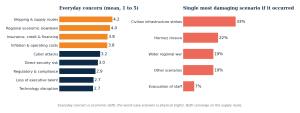
Two lenses on the same crisis. Everyday concern is economic (left); the worst-case scenario is physical (right). Both converge on shipping and Hormuz

Shipping is the exposure rated most serious on both lenses, yet it is also the one leaders feel least prepared for. Risk posture has been strengthened broadly, but route contingency, meaning alternative corridors, inventory cover and insurance capacity, has not kept pace. For most boards, that is the clearest unhedged gap in the picture.
Signal three: confidence is cautious, and growth runs on digital and deals
The upside is real but measured. A third of executives are confident of meeting their three-year GCC growth objectives, with a further 56% moderately confident and only about one in ten expressing low confidence. When it comes to where that growth will come from, partnerships and M&A lead the agenda, closely followed by digital transformation, with market expansion and AI deployment close behind.
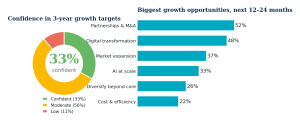
There is a paradox worth naming. Government-led mega-projects (67%) and growing consumer demand (56%) are the market dynamics executives most credit for supporting their growth, yet more than three quarters direct 30% or less of their capital, talent and leadership time toward national diversification agendas such as Vision 2030. Leaders are riding the demand these programmes create while keeping direct exposure modest, capturing the spillover and holding capital flexible against the risk backdrop.
Signal four: pay opens the door, culture closes it
The talent story turns on a mismatch. Compensation and tax treatment is the near-universal magnet drawing executives to the Gulf, cited by 97%, and it also tops every lever leaders reach for to retain their people. Yet when executives actually leave, the number-one reason is culture and leadership, not pay.
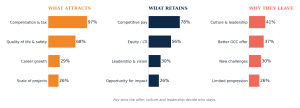
Leaders lean on compensation to keep talent, yet people walk over culture and leadership, a lever that pay cannot pull.
The implication for retention strategy is direct. Compensation is necessary to win the offer, but it does not decide tenure. Organisations that want to keep senior talent will need to treat culture, leadership quality and a credible sense of purpose as retention infrastructure, not soft extras. That matters more given a second finding on readiness: half of the executives who answered do not believe they have a robust succession plan for critical CXO roles, the weakest signal in the entire study.
Signal five: ambition is outrunning leadership supply
The capabilities executives say are hardest to find or build are precisely the ones the growth story depends on. AI literacy and data-driven decision making top the list of scarce leadership skills, followed by digital transformation leadership and an innovation mindset. Those are the same capabilities behind the region’s biggest growth bets.
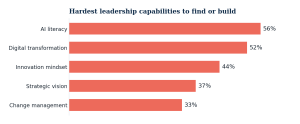
Two further readings sharpen the point. Prior GCC or wider Middle East experience is now called very important or essential by fewer than half of executives, down from earlier readings, a sign that boards are widening the aperture on where leaders can come from. And most organisations (74%) already blend an internal pipeline with external search when filling critical CXO roles. The message for talent strategy is that the region’s growth ambitions rest on capabilities its leadership market cannot yet supply on its own, which puts a premium on deliberate development and well-targeted external search.
Two poles: the UAE for ease, Saudi Arabia for scale
Geography matters. Executives draw a sharp distinction between where business is easiest to conduct and where the largest opportunity sits. On ease of doing business, the UAE stands clearly apart, with four in five rating it easier than its peers. Saudi Arabia is seen as the most challenging on regulatory and administrative friction, yet it is named just as often as the UAE as the most attractive growth opportunity, on the strength of its scale and reform agenda.
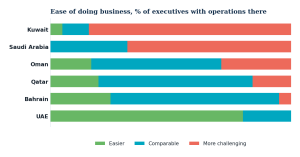
Ease of doing business, as rated by executives with operations in each market. Read the Kuwait and Bahrain readings with some care.
On the movement of leadership talent, the region looks broadly settled rather than draining: half of executives see the GCC as broadly balanced, with a slight net outflow (29%) outweighing net inflow (21%). The tide is only marginally out. What keeps the Gulf attractive to international executives is, once again, compensation and tax treatment, followed by quality of life and safety.
What this means for boards over the next 12 months
Read together, the five signals point to four priorities for GCC boards and leadership teams:
- Stress-test the trade route, not just the perimeter. The biggest, least-hedged exposure is supply-route disruption. Contingency corridors, inventory cover and insurance capacity deserve board time before further physical-security spend.
- Fund the digital and AI leadership bench now. Growth is staked on the capabilities that are hardest to hire. Treat AI-literate and digital leadership as a search-and-development priority, not a nice-to-have.
- Fix the culture lever, not only the pay lever. Compensation wins the offer; culture and leadership win the tenure. Retention strategy should address why people actually leave, and close the succession gap that half the room now reports.
- Match market strategy to market character. Play the UAE for ease and Saudi Arabia for scale, resourcing each accordingly rather than treating the GCC as one undifferentiated market.
The conversation continues in 2027
This is a first reading, taken during an unusual moment. A second wave in Q1 2027 will show whether the economic fear, the leadership-capability gap and the culture-driven attrition move as the situation evolves. To discuss what these findings mean for your leadership team, or to take part in the next wave, contact us at jjager@spenglerfox.com.
About SpenglerFox. SpenglerFox is a global people-solutions firm supporting organisations across executive search, leadership assessment and talent advisory. Our Global Business Insights programme brings evidence to the decisions leaders face in complex, fast-moving markets.