The CEO Succession Imperative: Why Growth Companies Can’t Afford to Leave Leadership Continuity to Chance
CEO succession is one of the most consequential decisions any organisation makes. Yet for growth companies, whether scaling mid-market businesses, founder-led enterprises, or private equity portfolio companies, succession planning remains dangerously neglected.
The statistics are sobering: over 70% of CEOs at PE-backed companies are replaced during the average hold period, according to a recent peer research paper from 2024-2025. Harvard Business Review research reveals that poorly managed CEO transitions destroy close to $1 trillion in value annually among S&P 1500 companies alone. And founder-CEO transitions carry a failure risk two to three times higher than other leadership changes.
For growth companies without the deep leadership benches of large multinationals, these risks are amplified. The CEO who built the business from £10m to £50m may not be the leader to take it to £200m. The founder who created the culture may struggle to professionalise operations for institutional investors. The private equity-backed CEO may face compressed timelines and intense value creation pressure.
This white paper examines the unique CEO succession challenges facing growth companies and PE-backed businesses, drawing on recent research from Harvard Business Review, Deloitte, PwC, and leading executive search firms. We explore the critical pitfalls that derail transitions and the strategic approaches that transform succession from existential risk into competitive advantage.
The Succession Crisis in Numbers
CEO turnover has reached unprecedented levels, yet succession planning has failed to keep pace. The gap between the frequency of transitions and organisational preparedness represents one of the most significant governance failures in modern business.
Rising Turnover, Declining Preparedness
The evidence is stark:
- CEO succession rates climbed to 12.5% in 2025, up from 9.8% in 2024, according to research published in Harvard Business Review by The Conference Board.
- Global CEO turnover hit a six-year high in 2024
- Median CEO tenure among S&P 500 companies has decreased 20% in less than a decade, from six years in 2013 to 4.8 years in 2022, according to Harvard Law School research cited by Deloitte.
- Yet only 21% of organisations have a formal CEO succession plan, according to a 2023 Deloitte report.
The disconnect is particularly acute in the private equity world. Recent surveys conducted in 2024 and 2025 found that PE portfolio company boards often lack clarity about who is responsible for succession planning – whether it sits with the portfolio company board, the board chair, the PE firm’s head of talent, or investment professionals.
The Cost of Getting It Wrong
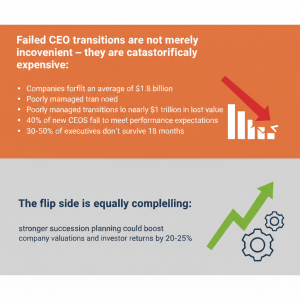
Failed CEO transitions are not merely inconvenient – they are catastrophically expensive:
- Companies that have to force out their CEO forfeit an average of $1.8 billion in shareholder value compared with companies that execute planned transitions, according to PwC Strategy & research.
- Poorly managed CEO and C-suite transitions may result in nearly $1 trillion in lost value annually in the S&P 1500 alone, according to analysis published in Harvard Business Review.
- 40% of new CEOs fail to meet performance expectations in the first 18 months, according to Harvard Business Review research.
- Center for Creative Leadership research reported by Forbes found that 30-50% of executives don’t survive 18 months from their promotions.
The flip side is equally compelling: stronger succession planning could boost company valuations and investor returns by 20-25%, according to Deloitte analysis of Harvard Business Review research.
Why Growth Companies Face Unique Challenges
CEO succession in growth companies bears little resemblance to succession at established multinationals. The playbooks that work for Fortune 500 companies with their deep leadership benches, decades of institutional memory, and stable competitive positions, simply don’t apply.
The Leadership Bench Problem
Large corporations systematically develop CEO candidates over 15-20 year careers, rotating high-potentials through divisions, geographies, and functions. Growth companies don’t have this luxury. Their leadership teams are often small, recently assembled, and focused on immediate operational challenges rather than long-term development.
The result: when succession becomes necessary, growth companies face an uncomfortable choice between promoting someone who may not be ready and conducting an external search in compressed timelines. Neither option is ideal, and both carry significant execution risk.
The Founder Transition Challenge
Founder-led companies face succession challenges that are both strategically complex and emotionally charged. Recent Harvard Business Review research (January 2026) found that founder-CEO handovers carry a risk of failure or performance downturn two to three times greater than transitions involving non-founder CEOs.
The reasons are multifaceted:
- Identity fusion: Founders often can’t separate their personal identity from the company they built, making ‘letting go’ psychologically difficult.
- Shadow authority: Even when founders formally step back, their continued presence can undermine successor authority and create confusion about decision rights.
- Culture preservation anxiety: Founders fear that professional managers will destroy the distinctive culture that drove early success.
- Capability mismatch: The entrepreneurial skills that built the company are rarely the same skills needed to scale it.
As research from a prominent leadership advisory firm in 2024 noted in their analysis of Brazilian founder transitions: “What brought the company here is not what will take it to the future. The leader’s profile must evolve.”
The Private Equity Pressure Cooker
Private equity ownership creates succession dynamics that are fundamentally different from publicly traded or family-owned businesses:
- Compressed timelines: With typical hold periods of five to six years and exit timelines increasingly extended, PE investors now face more leadership changes than traditional approaches anticipated.
- Transformation imperative: PE-backed CEOs face intense pressure to execute value creation plans at pace – a fundamentally different mandate than maintaining steady-state operations.
- Board composition gaps: PE portfolio company boards typically comprise investment professionals and sector experts, often lacking directors with CEO succession experience.
- Misaligned expectations: Recent research found that 78% of PE respondents identified ‘change of pace’ as a source of conflict with portfolio company CEOs, with performance targets being the second most contentious issue.
According to Michael Klingler, Head of Private Equity, Life Sciences & Healthcare at SpenglerFox, PE executives consistently cite leadership effectiveness as the most important lever for creating value in their portfolios. Yet succession planning remains one of the least developed capabilities in most PE-backed companies.
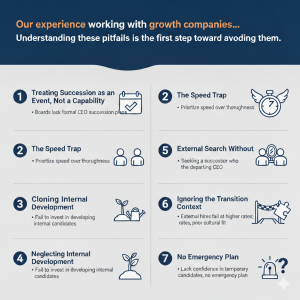
The Seven Deadly Sins of CEO Succession
Our experience working with growth companies across industrial, consumer, life sciences, healthcare and private equity sectors has revealed consistent patterns of failure. Understanding these pitfalls is the first step toward avoiding them.
1. Treating Succession as an Event, Not a Capability
Too many boards treat CEO succession as a one-time project triggered by a departure announcement, rather than an ongoing strategic capability. As the US National Association of Corporate Directors (NACD) observed in their 2024 Private Company Survey, many private boards lack formal CEO succession plans, leaving them unprepared to replace leaders despite recognising its critical importance.
2. The Speed Trap
When a CEO departure is announced, boards often prioritise speed over thoroughness. BTS research published in NACD’s Directorship magazine warns: “Speed has been the guiding philosophy for years when filling executive positions… it’s not conducive to making solid or thoughtful placement decisions.”
3. Cloning the Incumbent
Boards often default to seeking a successor who resembles the departing CEO. This approach ignores a fundamental truth: the capabilities that drove past success are rarely identical to those required for future challenges. Growth companies in particular need CEOs whose profiles evolve with the company’s stage and strategic needs.
4. Neglecting Internal Development
While internal candidates bring institutional knowledge and cultural fit, many growth companies fail to invest in developing them to CEO readiness. The result: when succession becomes necessary, internal candidates may have potential but lack the experience, exposure, and board relationships needed for success. Companies then default to external searches that could have been avoided.
5. External Search Without Context
External CEO hires fail at higher rates than internal promotions, particularly when boards don’t rigorously assess cultural fit and transition support needs. The 2024 CEO Succession Practices report from The Conference Board found that 77% of S&P 500 CEO hires were internal, reflecting institutional learning about external hire risk. Growth companies, with their distinctive cultures and informal operating styles, face even greater external hire integration challenges.
6. Ignoring the Transition Period
Succession planning focuses on selection; transition planning focuses on success. Too many boards declare victory when a new CEO signs their contract, neglecting the critical first 100 days that determine long-term outcomes. Transition planning is a distinct process that needs attention and planning, separate from succession planning itself.
7. No Emergency Plan
Unexpected CEO departures, whether from health issues, resignation, or termination, require immediate response. Yet, half of board directors don’t have confidence in an internal CEO candidate even on a temporary basis. Around a quarter don’t even know what their emergency CEO plan would be. For growth companies, this lack of preparedness can be existential.
Building Succession as a Strategic Capability
The best-governed growth companies treat CEO succession not as a periodic project but as an embedded capability. Drawing on research from PwC, Deloitte, and our own observations over the past decade, we identify the practices that distinguish successful succession processes.
Start with Strategy, Not Candidates
PwC’s research on CEO succession best practices emphasises that successful succession discussions begin by assessing factors likely to impact the business in the next few years. Only then can boards define the capabilities required for the next CEO and evaluate candidates against that profile.
For growth companies, this means asking hard questions: What stage will the company be in when succession occurs? What capabilities drove success to this point, and which new capabilities will the next phase require? How might the competitive landscape, technology, or regulatory environment evolve?
Build the Pipeline Early
Deloitte research found that 82% of CEO respondents are involved in identification of the CEO candidate pipeline, and 91% are involved in developing potential successors. Yet many CEOs, particularly founders, resist this responsibility, viewing it as threatening rather than essential.
The mindset shift required is significant. As one CEO with 27 years of experience told Deloitte: “To move your company forward requires you to develop very capable talent who could succeed you.”
Assess Objectively
Internal candidates are often evaluated through the lens of personal relationships and historical performance. External candidates may be assessed primarily on credentials and interview charisma. Neither approach predicts CEO success.
PwC recommends that boards adopt an analytical and evidence-based approach to assessing CEO candidates to reduce bias. This includes psychometric assessment, structured interviews against defined competencies, and rigorous reference checking that goes beyond provided references.
Benchmark Against the Market
Even when boards are committed to internal succession, understanding the external talent market sharpens decision-making. Confidential benchmarking of internal candidates against external alternatives provides context for readiness assessment and helps boards avoid both promoting too early and missing internal talent.
Plan the Transition, Not Just the Selection
The period between CEO selection and established leadership is fraught with risk. Successful transitions require structured support: stakeholder mapping, priority setting, board relationship building, and integration support that accelerates time-to-impact.
For founder transitions, post-transition interaction between the founder and new CEO often starts intensely but should gradually taper over time. Structured handover plans help manage this dynamic, preserving institutional knowledge while establishing successor authority.
Prepare for Emergency
Every board needs an emergency succession plan that identifies who would step in immediately if the CEO became unavailable. Best practice states that emergency CEO candidates must spend time with the board and current CEO to better understand the business, ensuring they can step in smoothly if needed.
CEO Succession in Private Equity: A Special Case
Private equity ownership creates distinct succession dynamics that require tailored approaches.

Integrate Succession into Talent Strategy
PE firms that treat talent strategy and management as core drivers of value creation, and not as an afterthought, are best positioned for success. This means integrating succession planning into the overall talent strategy rather than treating it as a separate board responsibility.
Clarify Responsibilities
The research revealed significant confusion about succession planning ownership in PE-backed companies. Best practice requires explicit agreement on whether the portfolio company board, board chair, PE firm talent function, or deal team owns the succession process, and how they coordinate.
Consider Sequenced Leadership Solutions
Not every PE deal requires the same CEO profile throughout the hold period. Some investments benefit from a ‘transformation CEO’ in the early post-acquisition phase, followed by a ‘scale CEO’ as the company matures. Building flexibility into leadership planning allows PE investors to match leadership to stage.
Use Interim Solutions Strategically
When CEO transitions can’t wait for permanent solutions, experienced interim executives can provide bridge leadership. This is particularly valuable in PE contexts, where business momentum and deal timelines create pressure that permanent search processes can’t always match.
How SpenglerFox Helps Growth Companies Navigate CEO Succession
Since 2003, SpenglerFox has partnered with growth companies across industrial, consumer, life sciences, heatlcare and private equity sectors. We understand that CEO succession in these contexts requires different approaches than traditional executive search.
Succession Readiness Assessment
We help boards understand their succession starting point: board readiness for transition, internal talent pipeline strength, CEO timeline expectations, and the leadership profile your strategy demands. This diagnostic provides clear-eyed insight into succession readiness and gaps requiring attention.
Internal Candidate Evaluation
We apply rigorous, objective assessment to internal CEO candidates, evaluating them against the leadership profile your next chapter requires – not your last one. Our assessment identifies development needs, readiness timelines, and whether internal succession is genuinely viable.
External Benchmarking and Search
We provide confidential benchmarking of internal candidates against external talent, and execute external searches when needed. Our deep expertise in growth company leadership means we identify candidates who have successfully navigated similar transitions, not just executives with impressive CVs.
Transition Support
We support new CEOs through the critical first 100 days, helping them build stakeholder relationships, establish priorities, and accelerate into the role. For founder transitions, we help structure ongoing founder involvement in ways that preserve value while establishing successor authority.
Interim Leadership
When succession timelines compress unexpectedly, our Executive Interim Management capability provides experienced executives who can stabilise, transform, or scale your business while permanent solutions are developed.
Conclusion: Succession as Competitive Advantage
CEO succession is too important to leave to chance. For growth companies, whether founder-led, PE-backed, or independently scaling, proactive succession planning transforms existential risk into competitive advantage.
The research is clear: companies that invest in succession as an ongoing capability outperform those that treat it as an emergency response. They retain more value during transitions, select better-matched leaders, and provide those leaders with the support needed for success.
The question for growth company boards is not whether CEO succession will become relevant: it’s whether you’ll be ready when it does.
Let’s Start the Conversation
Whether you’re planning years ahead or responding to an immediate need, the right time to discuss CEO succession is now.
Contact SpenglerFox to explore how we can help your board build leadership continuity.
spenglerfox.com/contact-us